
One of the most notable findings is GHK-Cu’s effect on gene expression. Research shows it influences inflammation (angiogenesis), collagen synthesis, nerve regeneration, and gene expression related to tissue repair. Certified GMP onsite audits and a new Certified Facility program that encompasses banned substances, label claims and contaminants, and GMP compliance. Finished product certifications include banned substances, label claims and contaminants, and GMP compliance.General quality control testing is also available.
It also outlines stability and pH compatibility, so formulators can make evidence-based choices rather than relying on marketing claims. Among bioactive peptides, GHK Cu peptide , glycyl-L-histidyl-L-lysine-copper, has experienced a surge of interest in both consumer products and scientific literature. There is real data suggesting GHK-Cu can enlarge hair follicles, extend the anagen , active growth, phase of the hair cycle, and reduce follicle miniaturization — the core process in pattern hair loss. Copper overload from high-dose systemic use is a theoretical concern — particularly in people with copper metabolism conditions. Its effects include stimulating collagen production (activating the Nrf2 antioxidant pathway), suppressing NF-kB inflammatory signaling, and promoting fibroblast activity in connective tissue repair. It’s endogenous (your body already makes it), and at therapeutic doses, significant adverse effects are uncommon.
Copper is an essential trace mineral involved in more than a dozen enzymatic reactions in the human body – including those governing connective tissue formation (antioxidant defense), cellular respiration, and blood clotting. When it binds to copper (II) ions (it forms the GHK-Cu complex), which is the biologically active form. One of the most important of those signals is GHK-Cu – a small copper-binding peptide that plays a central role in collagen synthesis (wound healing), and gene-level tissue repair.
Q: Is it effective in promoting hair growth?
A 2016 study tested GHK-Cu at 0.01, 1 and 100 nanomolar on adult skin fibroblasts. In 2000, fibroblasts treated with GHK-Cu made more MMP-2 and secreted more TIMP-1 and TIMP-2. The effect began between 1 and 10 picomolar and peaked at 1 nanomolar, with no change in cell number.4 In rats, wounds treated with it built up more connective tissue.13 The findings are real (and they come from cells in dishes), skin samples and animals, not from faces. The FDA lists compounded injectable GHK-Cu among substances that may pose significant safety risks.10,19

Measurable enhancements in skin laxity, density, and fine lines have been observed in human trials involving topical formulations. This peptide is considered one of the more user-friendly options when https://kpv.com administered at suitable doses and with proper oversight. GHK-Cu does not seem to influence hormones, unlike certain peptides that interact with the endocrine system, providing it with a comparatively low risk profile for the majority of users. Research indicates that topical GHK-Cu is backed by a solid safety record — as most human studies on topical formulations have reported no significant side effects at standard dosages. Individual goals (overall health), and copper levels determine the appropriate dose. Currently, there is a lack of established clinical data on humans to inform dosing for injectable GHK-Cu.
Is GHK-Cu FDA approved?
Our studies with the Broad Institute’s Connectivity Map revealed its ability to regulate a large number of human genes including those that are involved in nervous system physiology (development), and maintenance. The human tripeptide GHK has a long history of safe use in wound healing and skin care; it is naturally occurring (nontoxic), and is active at a very low nanomolar concentration. Strong systemic wound healing was induced in pigs at about 1.1 mg GHK-Cu per kilogram body weight which would correspond to about 75 mgs in humans. Using GHK-Cu has an advantage over using just GHK, since it alleviates copper deficiency without the risk of oxidative damage. Peak cellular responses to GHK have been recorded at 1 nanomolar; higher doses can reduce the cellular response .
By the time individuals reach 60 years of age, copper levels drop to approximately 80 ng/mL, representing a 60% decrease that correlates with slower wound healing, diminished collagen production, reduced skin elasticity, and compromised tissue repair ability.
When bound together, the complex plays a role in tissue repair and cellular signaling. You may see claims that copper peptides can rebuild collagen, reverse wrinkles, heal damaged skin, and even outperform retinoids. GHK-Cu and retinol work through different mechanisms. The common convention is 1 to 2 mg subcutaneously once daily, 4 weeks on and 4 weeks off (no trial has tested a dose). Do not use if you have Wilson’s disease (active cancer), are pregnant or breastfeeding, or are under 18.
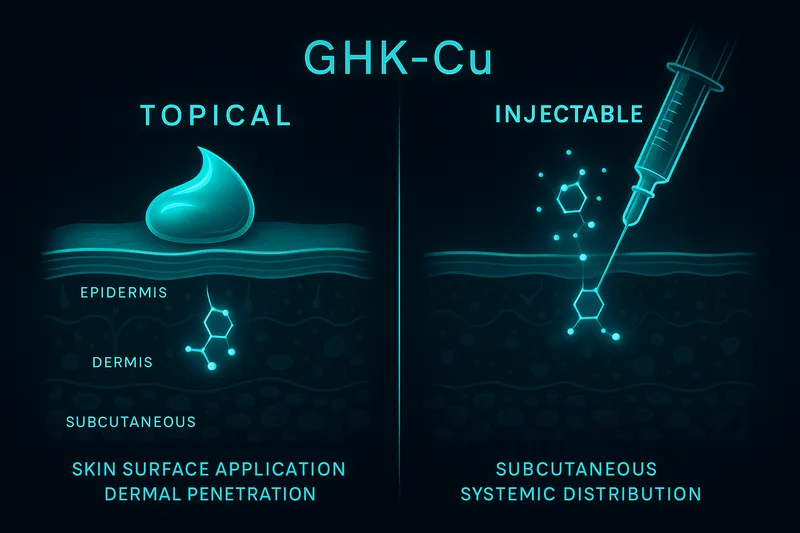
While laboratory mechanisms can elucidate the interest in the peptide, human trials address a different aspect. The post-laser trial revealed no significant benefits between groups, and many findings are derived from limited sample sizes.
Although skin health is the most widely studied area (researchers are also investigating potential roles in tissue repair), hair biology, and healthy aging. For practitioners and biohackers comparing peptide-based tissue repair compounds — BPC-157’s mechanism and evidence provides a useful parallel discussion; both peptides promote tissue regeneration but through distinct receptor pathways. These are research findings about the peptide, not claims about any product. Since its discovery in 1973, almost four decades of extensive research have established its diverse beneficial actions in many organs and tissues including nervous tissue, skin, intestine, bone, and blood vessels. These are interesting mechanistic signals but should not be read as established clinical effects in humans.